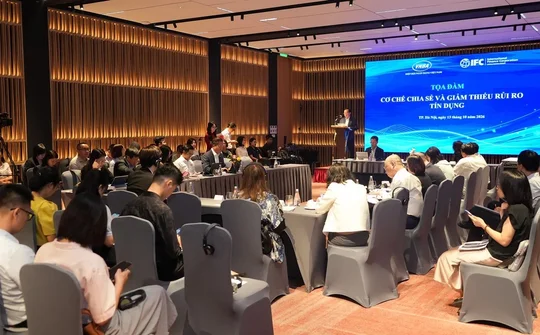

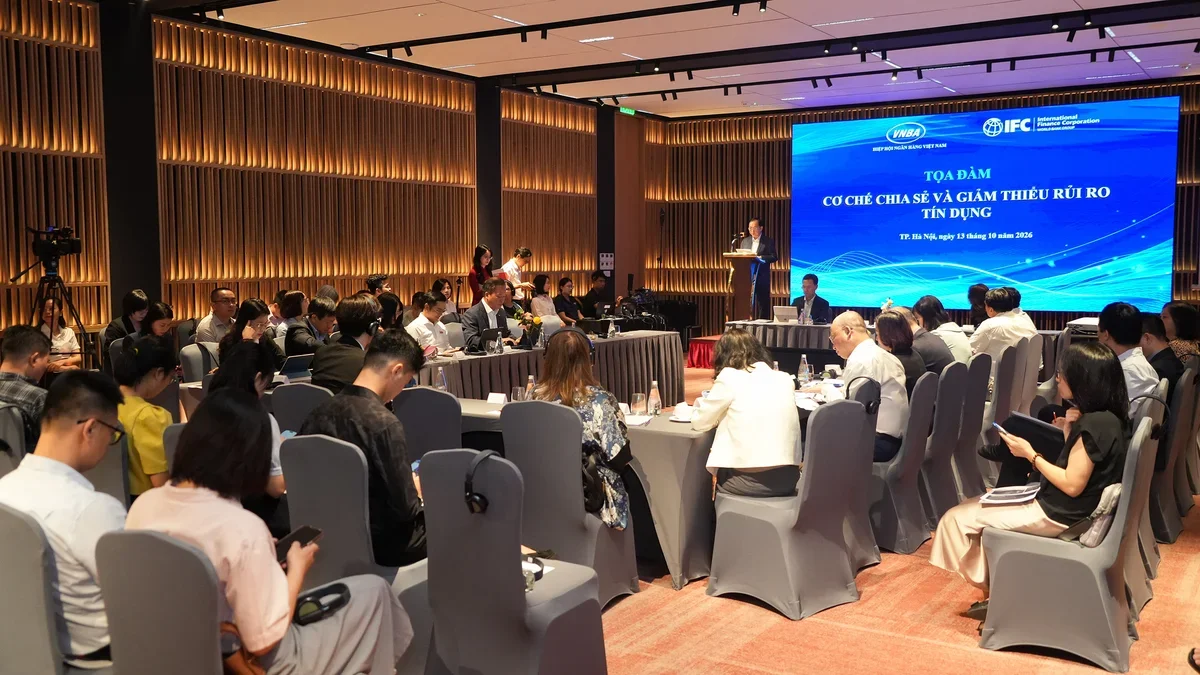
On October 13, 2026, in Hanoi, VNBA and IFC jointly organised a roundtable on credit risk-sharing and risk mitigation mechanisms in Vietnam, bringing together representatives of the State Bank of Vietnam (SBV), commercial banks, legal experts, IFC and the World Bank Group.Participants discussed international experience, the potential application of risk-sharing instruments, and the need to strengthen the legal framework to expand access to finance for businesses, particularly small and medium-sized enterprises (SMEs), while safeguarding the stability of the banking system.
The discussion introduced a range of risk-sharing instruments, including the Risk Sharing Facility (RSF) and Partial Credit Guarantee (PCG), while examining international experience and the conditions required for their implementation in Vietnam. These mechanisms offer potential avenues for mobilising additional private-sector resources, directing credit towards priority sectors and improving access to finance for businesses that face difficulties meeting conventional lending requirements.
Rising financing needs call for more tailored credit solutions

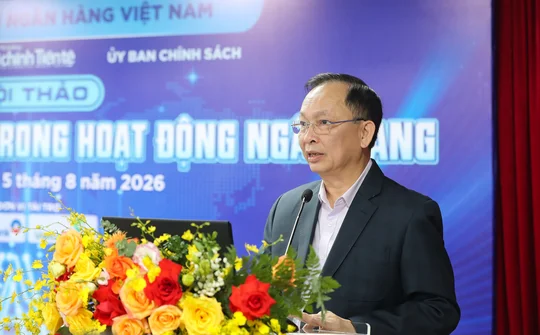
Dr. Dao Minh Tu, Vice Chairman and Secretary General of VNBA
In his opening remarks, Dr. Dao Minh Tu, Vice Chairman and Secretary General of VNBA, noted that Vietnam aims to achieve average annual economic growth of at least 10% during the 2026–2030 period. Achieving this target will require a continued increase in financing, particularly for infrastructure development, the green transition, digital transformation and modern agriculture.
According to figures presented at the roundtable, total outstanding credit across Vietnam’s banking system reached VND 20.75 quadrillion as of September 30, 2026, up 11.59% from the end of 2025 and 16.69% year on year. The continued expansion of credit places greater demands on credit institutions to strengthen risk management, maintain capital adequacy and preserve asset quality.
Meanwhile, many SMEs continue to face difficulties in obtaining bank financing because of limitations in financial reporting transparency, cash-flow documentation, business plans and collateral. As a result, some businesses struggle to meet lending requirements despite having genuine financing needs for their production and business activities.
Dr. Dao Minh Tu emphasized that credit risk-sharing and mitigation mechanisms could help banks serve customer segments with limited collateral or credit histories while mobilising additional private financial resources. However, the objective is not to relax credit standards, but to ensure that risks are properly identified, appropriately allocated and effectively controlled. Implementation requires a clear operational framework, transparent coordination arrangements and well-defined rights, obligations and responsibilities for all participating parties.
Representatives of the World Bank Group also highlighted the importance of SMEs to Vietnam’s economy. Figures presented at the roundtable indicated that SMEs contribute approximately 40% of GDP and account for 50% of employment. According to IFC estimates, around 62% of SME financing needs remain unmet, representing a financing gap of approximately USD 21.7 billion. In addition, Vietnam will require nearly USD 600 billion in new infrastructure investment by 2040, of which approximately USD 100 billion may be difficult to finance through public budgets and conventional bank lending alone.
These figures underscore the growing need to diversify funding sources and develop appropriate mechanisms for allocating and sharing financial risks.
Risk-sharing instruments offer new approaches to financing
At the roundtable, Mr. Takenori Matsuoka, IFC Chief Financial Specialist for Asia, introduced IFC’s credit guarantee and risk-sharing instruments and discussed how they might be adapted to Vietnam’s market conditions.
Under Partial Credit Guarantees or Full Credit Guarantees (PCG/FCG), IFC may guarantee part or all of a borrower’s debt obligations, subject to agreed terms and conditions. Where a borrower defaults and the applicable payment conditions are met, the guarantor fulfils its obligations under the guarantee. Such arrangements can strengthen lender protection and facilitate financing for eligible projects or borrowers.
Under Unfunded Risk Participation (URP), IFC shares the risk associated with loans already approved by a bank without necessarily providing funding upfront. The bank continues to manage the loans and pursue recoveries, with recovered amounts shared according to the agreed proportions.
The RSF, meanwhile, applies to a portfolio of loans that meets mutually agreed eligibility criteria. IFC and the participating financial institution share losses according to an agreed allocation, while the bank retains responsibility for originating, appraising and managing the loans and continues to carry the portfolio on its balance sheet. This approach may be suitable for expanding lending to SMEs, agriculture and other priority sectors.
Another instrument, Significant Risk Transfer (SRT), allows a bank to transfer part of a portfolio’s credit risk to a third party without selling the underlying loans. Where the relevant conditions are satisfied and the arrangement is recognised by the regulator, the instrument may reduce the bank’s risk-weighted assets and corresponding capital requirements.
According to information presented by IFC, the organisation currently has approximately 19 active credit guarantee programmes, with total committed own-account financing of around USD 1.3 billion. Experience in Nepal, Mexico, Morocco and Bangladesh demonstrates the potential application of risk-sharing instruments in digital infrastructure financing, sustainable bonds, SME lending, agriculture and renewable energy.
A 50:50 risk-sharing arrangement is one example of how banks may expand lending while retaining their central role in credit appraisal and management.
Nevertheless, the effectiveness of these instruments depends significantly on transaction design, portfolio eligibility criteria, loss-sharing arrangements and the enforceability of commitments between the parties.
Strengthening the legal framework for effective implementation
A key focus of the roundtable was identifying the legal issues that need to be clarified before RSF and PCG arrangements can be implemented in Vietnam.
According to an analysis by lawyer Nguyen Hung Quang of NHQuang & Associates, the legal readiness of the two instruments differs. For RSF, Vietnamese law does not yet contain specific provisions governing this risk-sharing model. The Law on Credit Institutions provides an initial basis through its provisions on forms of credit extension and related business activities, but further guidance from the SBV is needed to ensure consistent interpretation and implementation.
The legal nature of an RSF arrangement must be determined by reference to its specific transaction structure. RSF should not automatically be treated as equivalent to a guarantee under Vietnamese law. Under certain structures, the risk-sharing party has rights and obligations vis-à-vis the bank without entering into a direct contractual relationship with the borrower or directly seeking repayment from the borrower.
For transactions involving foreign institutions, whether an arrangement falls within the scope of foreign borrowing must also be assessed in light of its structure, funding characteristics and repayment obligations. Clearer classification, eligibility criteria and corresponding legal requirements are therefore needed for different models.
PCG has a more direct basis in the existing legal framework. Under Article 14 of Circular No. 41/2016/TT-NHNN, as amended and supplemented by Circular No. 22/2023/TT-NHNN, guarantees issued by international financial institutions may be recognised as credit risk mitigation measures for capital adequacy calculations, provided the prescribed conditions are met. Recognition is not automatic and depends on requirements relating to direct claims, irrevocability, timely performance of obligations, guarantee maturity and the creditworthiness of the guarantor.
In light of these issues, participants recommended that the SBV clarify the classification and eligibility requirements for RSF arrangements, including both funded and unfunded models. Further guidance is also needed on participation requirements, reporting, supervision, recognition of risk mitigation, foreign exchange and remittance rules, the rights and obligations of the parties, and dispute resolution.
For PCG, additional clarification is needed on its treatment in capital adequacy calculations, credit exposure limits and related regulatory requirements. A carefully designed pilot programme, with clearly defined scope, eligible portfolios, selection criteria and standardised transaction documentation, could help assess feasibility before any wider rollout.
Balancing credit expansion with banking system safety
From the commercial banking perspective, Ms. Dao Van Quynh, Deputy Head of Credit Risk Management at Vietcombank, said implementation should reflect operational realities and strike a balance between effective risk control and credit institutions’ autonomy. She also highlighted the need to clarify how transferred risks should be recognised and recommended a selective pilot approach.
Ms. Tong Dieu Linh, Director of the Transaction Banking Centre at VPBank, stressed that credit expansion must go hand in hand with prudent risk management and funding diversification. Risk-sharing instruments should be tailored to the characteristics of borrowers and products, as well as each bank’s risk appetite, enabling lending to expand without compromising credit quality.
Representing the regulator, Mr. Tran Anh Quy, Deputy Director of the Credit Department at the SBV, noted that the roundtable provided credit institutions with an opportunity to learn from international risk management experience and discuss how relevant models could be adapted to Vietnam’s circumstances.
The discussions underscored that risk-sharing mechanisms do not replace banks’ responsibilities for credit appraisal, loan management and debt recovery. Rather, they should be structured to allocate losses transparently, encourage effective risk management by all parties and preserve incentives for prudent lending decisions.
VNBA and IFC promote dialogue to identify solutions suited to Vietnam
Welcoming the participation of regulators, commercial banks, international financial institutions, businesses, legal experts and development organisations, Dr. Dao Minh Tu said the roundtable brought together a broad range of perspectives, helping to identify both the opportunities and the practical conditions necessary for implementing credit risk-sharing and mitigation mechanisms in Vietnam.
He reaffirmed VNBA’s readiness to continue serving as a bridge between regulators, credit institutions, IFC and development partners, facilitating in-depth dialogue and cooperation to identify solutions that respond to the market’s practical needs.
IFC also expressed its willingness to work with regulators, VNBA and financial institutions to continue discussions on the conditions required for implementing risk-sharing instruments.
The discussions are expected to provide the banking community with additional information, experience and practical insights for assessing RSF and PCG models. They may also lay the groundwork for deeper cooperation and the development of instruments suited to Vietnam’s market.
As financing needs continue to grow alongside the economy, strengthening credit risk-sharing mechanisms could provide a complementary means of expanding access to finance, mobilising private resources and improving credit allocation. Clear legal arrangements, transparent risk allocation and rigorous credit appraisal and risk management standards remain essential. These conditions will help ensure that new instruments deliver their intended benefits while safeguarding the safety and stability of the banking system.
VNBA News