
Wednesday, 16/09/2026
   

Seminar discusses how to successfully restructure banking sector

Experts explored the root causes behind both the successes and failures of Việt Nam’s bank restructuring efforts, while proposing practical measures to enhance their effectiveness going forward, at a seminar in HCM City on April 11.

Experts explored the root causes behind both the successes and failures of Việt Nam’s bank restructuring efforts, while proposing practical measures to enhance their effectiveness going forward at a seminar in HCM City on April 11.

Speaking at the forum titled 'Bank Restructuring: How to Achieve Maximum Efficiency?' held by Tiền Phong newspaper, Phùng Công Sưởng, the Editor-in-Chief emphasised that the Vietnamese banking sector is undergoing a pivotal transformation.
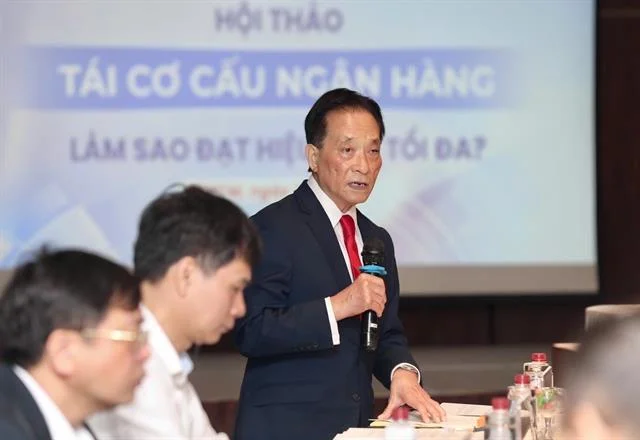
Dr Nguyễn Trí Hiếu, director of the Institute of Research and Development of Global Financial and Real Estate Markets, speaks at the seminar on 'Bank Restructuring: How to Achieve Maximum Efficiency?' held by Tiền Phong newspaper in HCM City on April 11.

The State Bank of Vietnam (SBV) has recently executed mandatory transfers of certain weak banks and is actively seeking investors for Saigon Commercial Bank (SCB). In this context, the seminar served as a timely platform for stakeholders to evaluate the ongoing restructuring process and propose optimal strategies, he said.

Việt Nam's banking history has witnessed multiple restructuring efforts with some successful, others offering sobering lessons, he said, adding that analysing past cases is essential to help policymakers and experts formulate effective solutions. The ultimate goal is not just to help weak banks overcome hardship, but to build a healthier, more transparent and resilient banking system that supports sustainable economic growth.

According to Nguyễn Xuân Thành, a public policy lecturer at Fulbright University Vietnam, Việt Nam currently has 35 commercial banks, five of which are under special control due to serious financial instability. While a competitive banking environment benefits businesses and depositors, it also increases the risk of market failures and makes regulatory supervision more difficult.

Since 2010, the banking sector has experienced explosive growth, with some banks expanding their scale by 10 to 15 times. While this rapid expansion has raised regulatory challenges, it also provides a solid foundation and an opportunity for comprehensive restructuring.

Thành noted that Việt Nam has used several restructuring approaches since 2011, including mergers, consolidations, the entry of new investors, and most notably, mandatory transfers.

He noted that one of the key drivers behind the weakness of joint-stock commercial banks is manipulation by large shareholder groups. These groups often establish cross-ownership structures to dominate decision-making, effectively bypassing regulations intended to ensure safe and sound operations.

Such banks frequently issued credit to affiliated companies and projects within their own ecosystems, many of which were poorly performing. The result was a rapid accumulation of non-performing loans and, ultimately, forced restructuring, he said.

Lawyer Trương Thanh Đức outlined the three main stages in handling weak banks: 'early intervention', followed by 'special control' and ultimately, 'mandatory transfer' or bankruptcy. Of these, mandatory transfer is considered the final measure before insolvency.

Mandatory restructuring is necessary because troubled banks rarely agree to voluntary handovers, Thành emphasised. No one wants to give up a bank for zero compensation, even if its financials are deeply negative. If a voluntary solution fails, the State must choose between forced transfer or bankruptcy.

Post-transfer strategies often include renaming the bank, retaining its licence, and eliminating brand value. Thành noted that this model closely resembles Indonesia’s approach to resolving its own banking crises.

The amended 2024 Law on Credit Institutions now provides a clear legal framework for mandatory transfers, allowing both credit institutions and non-bank enterprises to participate as transferees. However, this expansion has generated controversy, particularly over the financial and operational capabilities of non-bank participants.

Despite being the most feasible option in certain scenarios, mandatory transfers come with considerable risks

Director of the Institute of Research and Development of Global Financial and Real Estate Markets, Dr Nguyễn Trí Hiếu, cautioned that while mandatory transfers may be the most feasible solution in certain cases, they are not a panacea.

“Việt Nam carried out such transfers ten years ago, informally known as ‘zero-đồng acquisitions,’” he said. “Now we’re doing it again, but there’s no transparency about the new entities—how they operate, their capital structure, etc. Depositors face significant risks, especially since the national deposit insurance covers only a modest amount.”

According to Article 185 of the 2024 Law on Credit Institutions, transferee entities assume 100 per cent of the charter capital of the weak bank, but are not required to consolidate financial statements or include the acquisition in their capital adequacy ratios. This diverges from international accounting standards and could lead to major information gaps for shareholders, customers and regulators, he said.

To ensure the success of such restructurings, Hiếu proposed several measures.

The restructured bank must have a minimum charter capital of VNĐ3 trillion (US$117.6 million) and the parent bank must guarantee all customer deposits held by the restructured entity, he said.

He also urged the central bank to publish detailed information on the financial health of all commercial banks on its official website.
Theo VNS
  • Promulgation of Circular guiding payment and money transfer activities related to merchanting trade transactions

    Promulgation of Circular guiding payment and money transfer activities related to merchanting trade transactions

    On August 27, 2026, the State Bank of Vietnam (SBV) issued Circular No. 43/2026/TT-NHNN guiding payment and money transfer activities related to merchanting trade transactions.

  • Service segment becomes key sustainable profit source for banks

    Service segment becomes key sustainable profit source for banks

    Focusing on payment services, digital banking, bancassurance and wealth management is key for banks to maintain their competitive edge.

  • Banking Sector Digital Transformation Event 2026 to take place in Hanoi

    Banking Sector Digital Transformation Event 2026 to take place in Hanoi

    On August 11, 2026, in Hanoi, State Bank of Vietnam (SBV) held a press conference to announce the Banking Sector Digital Transformation Event 2026. This year's event is themed “Smart Banking in the Era of Data and AI", with the overarching message "Data leads the way, AI drives progress, banks build the digital ecosystem". The press conference was jointly chaired by leaders of the Payment Department, the Information Technology Department, and the Banking Times.

  • Shinhan Bank and Visa Launch Click to Pay, Enhancing the Online Payment Experience

    Shinhan Bank and Visa Launch Click to Pay, Enhancing the Online Payment Experience

    Ho Chi Minh City, August 28, 2026 – Shinhan Bank Vietnam Limited ("Shinhan Bank") in collaboration with Visa (“Visa”), has launched Click to Pay, a modern online payment solution that enables Shinhan Visa cardholders to make payments quickly, conveniently and securely without having to re-enter their card details for every transaction.

  • Shinhan Bank Vietnam Expands Foreign Exchange Financial Solutions for Customers

    Shinhan Bank Vietnam Expands Foreign Exchange Financial Solutions for Customers

    Shinhan Bank Vietnam recently hosted a seminar on the economy and the foreign exchange market for Private Wealth Management (PWM) clients in Hanoi on August 11, 2026, attracting nearly 100 attendees. The event aligns with the bank's strategic roadmap to expand financial solutions tied to foreign exchange, trade, and supply chains.

  • Prime Minister holds a working session with the State Bank of Vietnam and the system of credit institutions

    Prime Minister holds a working session with the State Bank of Vietnam and the system of credit institutions

    On the morning of August 13, 2026, at the Government Headquarters, Prime Minister Le Minh Hung chaired a strategic conference with the State Bank of Vietnam (SBV) and the system of credit institutions. The event aimed not only to assess the monetary landscape of the first seven months of the year, but also to chart the course for macroeconomic management, unlock capital resources, and elevate the operational quality of the financial system ahead of new economic challenges.

  • Data governance is the "key" to AI creating real value

    Data governance is the "key" to AI creating real value

    Data quality and governance capabilities are the decisive factors in the effective application of artificial intelligence (AI) in the banking industry – This was the message emphasized by Dr. Dao Minh Tu, Vice Chairman cum General Secretary of the Vietnam Banks Association (VNBA), at the seminar "AI and Data Governance in Banking Operations" on August 5, 2026.

  • The Banking sector rolls out credit program targeting economic growth drivers and SMEs

    The Banking sector rolls out credit program targeting economic growth drivers and SMEs

    The State Bank of Vietnam (SBV) recently issued Document No. 7125/NHNN-TD, dated August 7, 2026, addressed to commercial banks and SBV regional branches regarding the implementation of a credit program aimed at economic growth drivers and small and medium-sized enterprises (SMEs).

  • Temenos Asia-Pacific Forum 2026

    Temenos Asia-Pacific Forum 2026

    On August 25-26, 2026, in Hanoi, the “Temenos Asia-Pacific Forum 2026 (TRF’26 APAC)” will officially take place to update on development trends, digital transformation strategies, and advanced technologies in the finance and banking sector; and to share international experiences on the application of artificial intelligence (AI) in product and service development and improving the operational efficiency of financial institutions.

  • Strategic cooperation prospects between the fintech ecosystems of Vietnam and the United Kingdom: From market potential to technological execution

    Strategic cooperation prospects between the fintech ecosystems of Vietnam and the United Kingdom: From market potential to technological execution

    On the afternoon of August 12, 2026, in Hanoi, the Vietnam Banks Association (VNBA) held an official working session with a delegation of Fintech enterprises from the United Kingdom. The event opened a space for strategic dialogue regarding market dynamics, regulatory frameworks, and technological platforms, while simultaneously positioning profound collaborative opportunities between the financial technology communities of both nations.

Calculate deposit interest
VNĐ
%/year
month
Calculate deposit interest

Loan calculation
VNĐ
%/year
month
Loan calculation