
The working visit took place against the backdrop of robust growth in economic and trade relations between Vietnam and Australia following the elevation of their ties to a Comprehensive Strategic Partnership, a move that has opened up significant opportunities for large-scale cooperation in finance, banking, and financial technology (Fintech).
As part of the agenda, the VNBA delegation held a high-level meeting with the Australian Banking Association (ABA), hosted by Mr. Simon Birmingham (CEO) and Ms. Vanessa Beggs (Deputy CEO). The ABA currently represents 20 member banks, comprising major commercial banks, regional banks, international banks, and digital-only banks. Its operations are guided by senior leadership and the ABA Council—consisting of 16 representatives from member organizations—serving as the primary liaison between the banking sector and the Australian government and regulatory bodies.

During the meeting, ABA representatives outlined key policy priorities, focusing on enhancing access to transparent banking services, modernizing payment infrastructure, implementing industry-wide solutions to combat fraud, and enforcing the Banking Code of Practice. The latest 2025 update to the Code, approved by the Australian Securities and Investments Commission (ASIC), establishes high self-regulatory standards designed to provide enhanced protection for retail customers, small and medium-sized enterprises (SMEs), guarantors, and vulnerable customer groups—going beyond statutory minimum requirements.
Commending the ABA’s operational model and role, Dr. Dao Minh Tu noted that the VNBA shares many similarities regarding its functions and mission within the economy. VNBA leadership proposed strengthening comprehensive cooperation between the two sides by working towards a Memorandum of Understanding (MOU), sharing industry information, jointly organizing thematic seminars, and fostering connections between financial institutions and fintech companies in both countries. On this occasion, the VNBA delegation presented a copy of the monograph "Vietnamese Currency" to ABA leadership representatives.
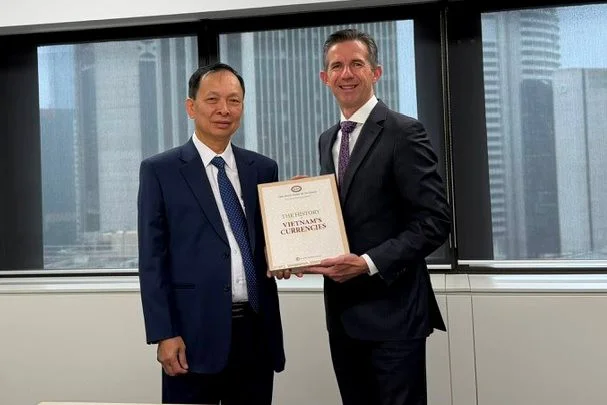
VNBA's Secretary General presented a copy of the monograph "Vietnamese Currency" to ABA leader
Notably, the ABA shared Australia's experiences in establishing a cross-sector data-sharing mechanism to combat financial crime through two key platforms:
The first is the Australian Financial Crimes Exchange (AFCX)—a non-profit platform established by major banks with the active participation of the Australian Taxation Office (ATO), telecommunications companies, and digital platforms. By operating the Fraud Reporting Exchange (FRX), the AFCX enables banks to instantly share data on suspicious transactions, fraudulent accounts, IP addresses, and signs of identity theft, creating an "anti-fraud information loop" that supports the timely prevention and freezing of fraudulent fund flows.
The second is the Consumer Data Right (CDR)—an Open Banking legal framework managed by the Australian Government that allows consumers to securely and proactively share their financial data with Accredited Data Recipients. This enables customers to easily compare products, apply for loans, switch service providers, or use personal financial management applications.

VNBA delegation visited and held a working session with N2N AI
Subsequently, the VNBA delegation visited and held a working session with N2N AI. In a meeting with the delegation, Mr. David Nguyen, CEO of N2N AI, introduced a Privacy-Preserved Sharing Platform specifically designed for the financial sector. Leveraging a combination of three advanced technologies—Homomorphic Encryption, Secure Enclaves, and Federated Learning integrated with Differential Privacy—the solution enables banks to collaboratively train AI models and conduct risk analysis without sharing or moving raw data outside their internal organizations.
By maintaining full data sovereignty within the originating bank, the solution ensures strict compliance with personal data protection regulations while facilitating real-time network fraud detection and expanding credit scoring capabilities based on alternative data (such as telecommunications, utility bills, and cash flow). Real-world implementation across a network of 300 banks has demonstrated an increase in fraud detection accuracy from 79% to 97%, a 5%–10% rise in credit approval rates, and a 15%–25% reduction in the incidence of bad debt.
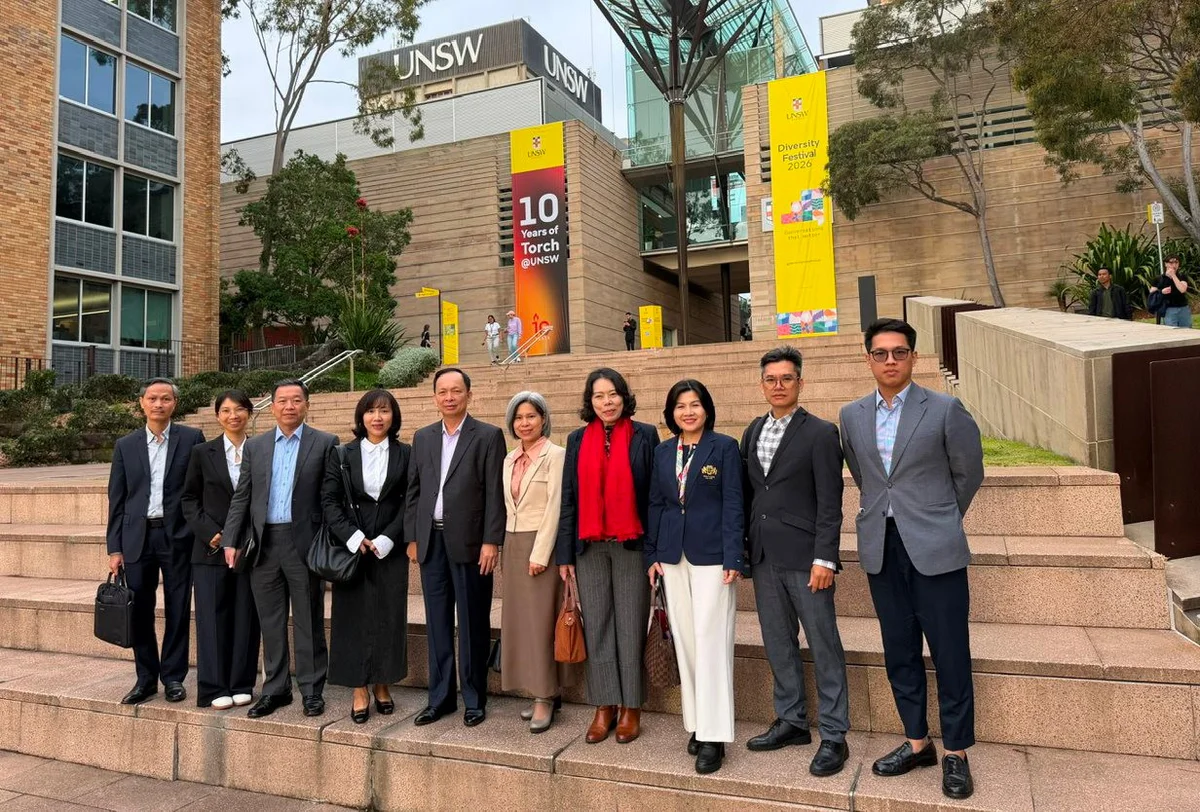
VNBA delegation to University of New South Wales
At the University of New South Wales (UNSW), Professor Wenjie Zhang, Deputy Head of the School of Computer Science and Engineering, presented the ARC Training Centre for Trustworthy Financial Intelligence project to the delegation. The project focuses on research into the real-time integration of multimodal financial data and the development of Responsible Generative AI (Responsible GenAI) models for applications in financial simulation, forecasting, and risk management.
The VNBA delegation’s business trip not only opened up practical prospects for cooperation in technology and fraud-prevention data sharing but also provided a comprehensive view of the robust capital buffers within the Australian banking system. The Australian banking sector currently serves as a solid pillar of the economy, underpinned by strict adherence to the "Unquestionably Strong Capital Framework" issued by the Australian Prudential Regulation Authority (APRA). Consequently, the capital adequacy ratios (CAR) and capital buffers of Australian banks consistently exceed regulatory minimums—reaching levels double those seen prior to the Global Financial Crisis (GFC 2007–2008)—thereby establishing a foundation of superior liquidity and resilience amidst global economic volatility.
VNBA News