

Dr. Dao Minh Tu, Vice Chairman and Secretary General of the Vietnam Banks Association
Attending and delivering opening remarks were Dr. Dao Minh Tu, Vice Chairman and Secretary General of the Vietnam Banks Association, and Mr. Jinchang Lai, Principal Operations Officer and Financial Infrastructure Lead for Asia Pacific, Financial Institutions Advisory Services Group at IFC, who also serves as Sherpa of the Financial Infrastructure Development Network (FIDN) under the APEC Business Advisory Council’s Asia-Pacific Financial Forum (APFF).
Trade Credit Insurance – An Important Tool for Modern Risk Management
In his opening remarks, Dr. Dao Minh Tu noted that amid ongoing global economic uncertainties, including slower economic growth, geopolitical risks, supply chain disruptions, and increasing volatility in international trade, strengthening risk management capabilities for both businesses and financial institutions has become increasingly critical.
According to Dr. Tu, as Vietnam continues to deepen its integration into the global economy, banks are not only providers of capital but also strategic partners supporting businesses in trade, import-export activities, and participation in global supply chains. In this context, the development of trade finance and supply chain finance products, accompanied by effective risk mitigation tools, is becoming a key trend in the financial and banking sector.
The VNBA leader emphasized that trade credit insurance is regarded as an effective instrument for mitigating non-payment risks in commercial transactions, helping businesses manage receivables more efficiently while enabling financial institutions to expand trade finance activities, improve credit portfolio quality, and enhance access to financing for businesses.
He further highlighted that in many developed economies, trade credit insurance has become an essential component of the modern financial ecosystem, contributing to trade growth, market expansion, and greater resilience against economic shocks.
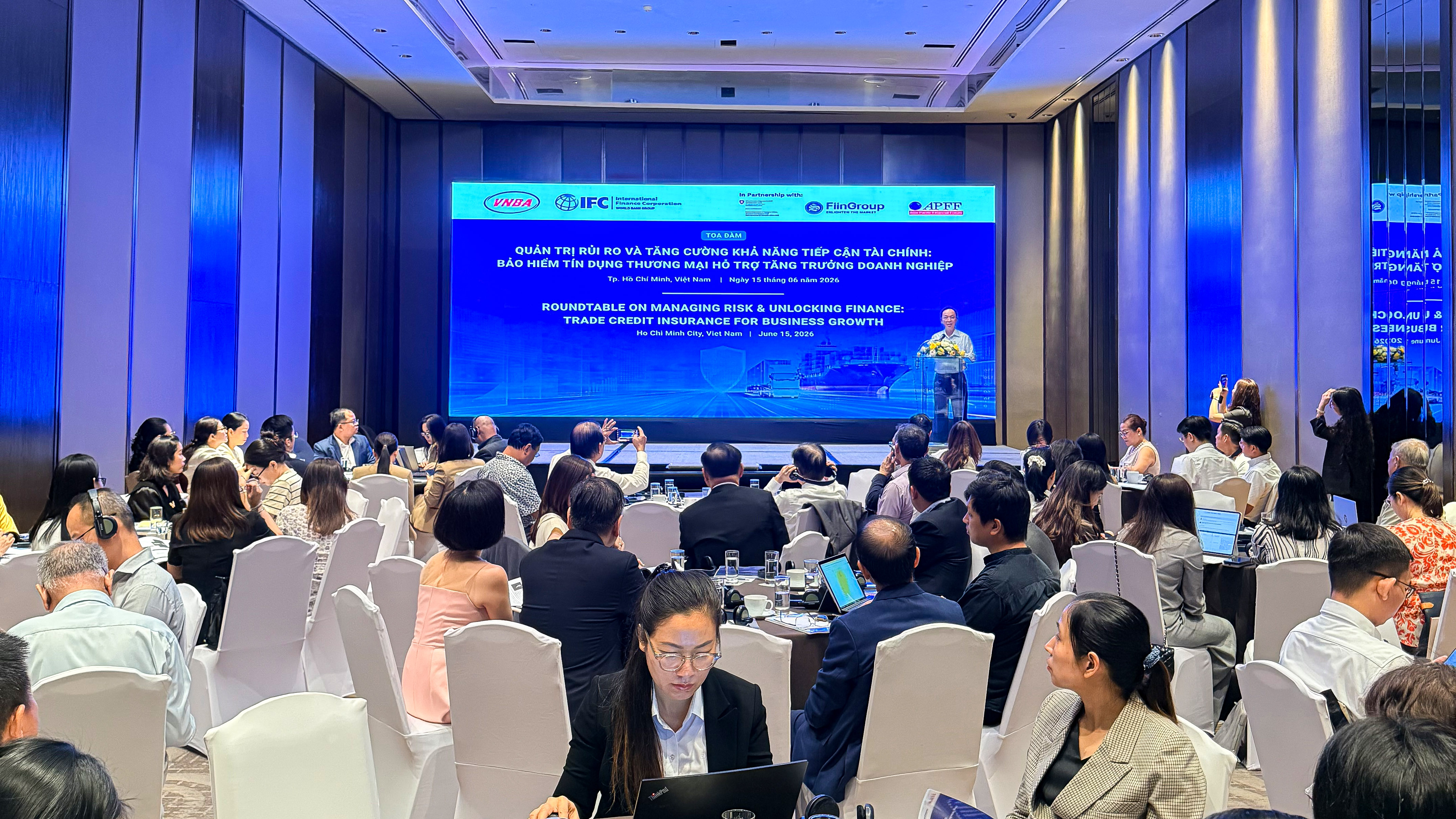
Overview of the roundtable
Strengthening the Link Between Supply Chain Finance and Trade Credit Insurance
During the session providing an overview of supply chain finance and trade credit insurance, Mr. Jinchang Lai emphasized that international trade today is not merely about buying and selling goods but also about effectively managing cash flows and risks across entire value chains.
According to the IFC expert, as businesses become increasingly integrated into global supply chains, demand for financing solutions based on cash flows, receivables, and actual business performance is growing rapidly. However, many enterprises, particularly small and medium-sized enterprises (SMEs), continue to face challenges in accessing finance due to limited collateral and insufficient credit histories.
In this context, integrating trade credit insurance with supply chain finance solutions can help reduce lending risks, improve credit assessment processes, and broaden financing opportunities for businesses.
Experts also noted that business data, advanced analytics, and digital platforms are becoming critical enablers for modern financing models, allowing financial institutions to move beyond collateral-based lending toward assessments based on cash flow, transaction history, and operational performance.
International Experience and the Role of Data in Trade Credit Insurance
At the roundtable, representatives from Coface, a leading trade credit insurance provider, shared practical experiences in managing buyer risk amid an increasingly volatile global economic environment. According to the speakers, monitoring customers’ financial health and utilizing appropriate trade credit insurance solutions enable businesses to proactively mitigate losses and support business expansion.
Meanwhile, representatives from FiinGroup highlighted the growing importance of data and analytics in enhancing the effectiveness of trade credit insurance products. Experts emphasized that business data has become a valuable asset, enabling financial institutions and businesses to assess risk more accurately and make better-informed credit and insurance decisions.
In particular, Mr. Wang Hui, a trade credit insurance expert from Hong Kong, shared international experiences on leveraging trade credit insurance as a tool to support business growth, facilitate trade, and improve access to finance for SMEs.
Building a Stronger Trade Finance and Risk Management Ecosystem
During the discussion and Q&A session, participants exchanged views on the opportunities and challenges associated with developing Vietnam’s trade credit insurance market. While acknowledging the sector’s significant growth potential, speakers emphasized that broader adoption of trade credit insurance would require close cooperation among regulators, financial institutions, businesses, insurance providers, and international financial organizations.
Experts recommended further improvements to the legal and regulatory framework, enhanced data-sharing mechanisms, wider adoption of digital technologies, and greater awareness among businesses regarding the benefits of modern risk management solutions.
Concluding the roundtable, participants agreed that trade credit insurance is increasingly becoming a vital component of the modern financial ecosystem, helping reduce risks, promote trade finance, and support business expansion. As Vietnam continues to integrate more deeply into global value chains, the development of advanced risk management solutions—combined with supply chain finance and effective utilization of business data—will serve as a crucial foundation for improving access to finance, strengthening business competitiveness, and supporting sustainable economic growth in the years ahead.
TTĐT